
AI won't fix your business.
But it will expose what's broken
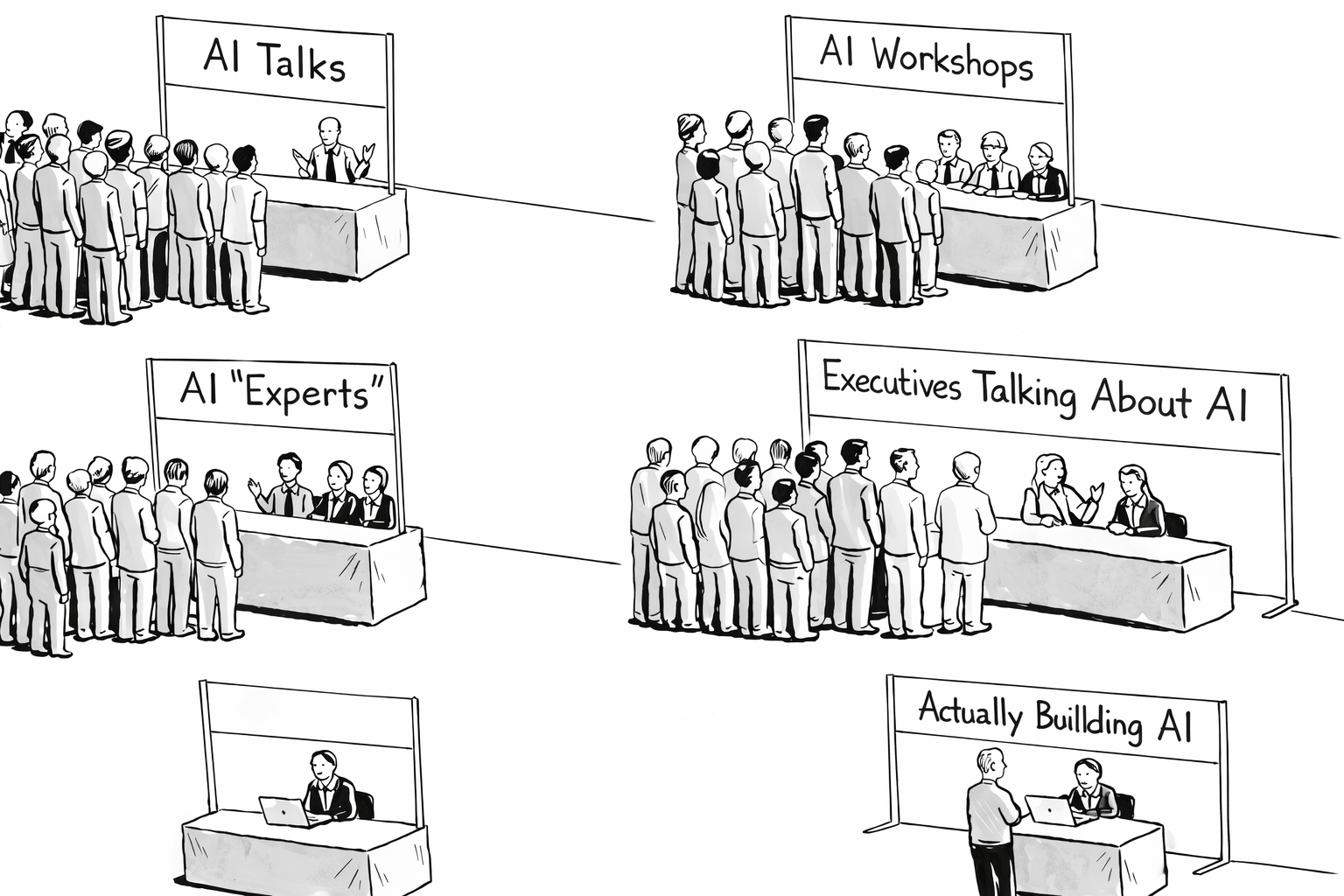
Got a guy in your network who suddenly became an AI expert last Tuesday? Yeah. Share this.
Everyone's rushing to adopt AI. But most people are skipping the one step that actually makes it work: understanding it.
Remember when every runner suddenly had those expensive, cushioned, carbon-plated shoes? People lined up, dropped $300, and hit the pavement — without knowing their gait, their arch, or whether that shoe was even built for them. A lot of them got injured. The shoe wasn't the problem. The blind adoption was.
AI is having that exact same moment right now. And if you've been to any conference, LinkedIn scroll session, or company all-hands recently, you already know what I'm talking about.
Thousands of people crowding into sessions about AI, and almost nobody sitting at the table doing the work. The gap between talking about AI and using it well has never been wider.
We've turned AI into a trend, not a tool
The signs are everywhere. You've got executives who discovered AI last quarter now mandating that their entire team "use AI" — without a strategy, without guardrails, and definitely without thinking about what data is being shared with which platform. You've got resumes that look flawless on paper but fall apart the moment the interview gets real, because it was the AI that wrote it, not the person sending it.
You've got people genuinely convinced that AI is creative. It's not. Every answer an AI gives you came from something a human wrote first. It's an extremely powerful remix engine — but the original ideas? Those came from us.
"The uncomfortable truth is that AI doesn't know more than us. Every single output it produces was built from information that humans put in first. It's a reflection — not a replacement."
And then there's the layoff conversation. Anytime a company downsizes right now, the internet immediately declares it's AI replacing workers. Sometimes that's true. But a lot of the time, it's companies using "AI efficiency" as a convenient cover story for decisions that had nothing to do with automation. Both things can be real — but collapsing every layoff into one narrative is lazy, and it spreads fear that doesn't help anyone.
The mistakes we keep dragging with us
Here's what's wild: we know what the common mistakes are. They're well documented. But instead of using that knowledge to avoid them, we keep carrying them into new projects, new hires, new strategies. Why?
Because it's faster. Or at least, it feels faster. Ask the AI to build the app. Ask the AI to fix your SEO. Ask the AI to make you more money. And in a tiny percentage of cases, something works out. But for most people, most of the time, that shortcut leads to a wall — and a confused team standing in front of it.
The problem isn't the technology. The problem is that we're reaching for the fast fix before we've taken the time to understand what we're actually solving, and whether AI is even the right fit for solving it.
🚩 Red flag — run, don't walk
If someone walks up to you and their first sentence is "you need AI" — that's a trap. They're not solving your problem, they're selling you the pill for the pain without ever asking where the pain comes from. A real diagnosis comes before any prescription. Anyone skipping that step is selling you something, not helping you.
This is how bad AI adoption spreads: not through malice, but through shortcuts dressed up as urgency. "Everyone's doing it" is not a strategy. "We need to move fast" is not a diagnosis. And the consultants cashing in on that fear? They'll be long gone by the time you realize the root problem was never touched.
So what actually works?
The teams and individuals getting real, sustainable results from AI aren't the ones who adopted it fastest. They're the ones who combined it with something AI can't replace:
AI + Education + Human touch = something that actually scales
Education here doesn't mean watching a 10-minute YouTube video. It means ongoing, deliberate learning — understanding what AI can and can't do, where it hallucinates, where it shines, and where human judgment is non-negotiable. Human touch means knowing that a client relationship, a product decision, or a piece of creative work still needs you in it — not just your prompt.
The smartest person in the room isn't the one who knows the most. It's the one who adapts the best. AI is a tool for adaptation — but only if you know what you're adapting toward.
So before the next AI conference, before the next mandate to "use AI more," maybe the more useful question is: do we actually understand what we're using, and why?
Because the runners who actually got faster? They learned the basics first.